

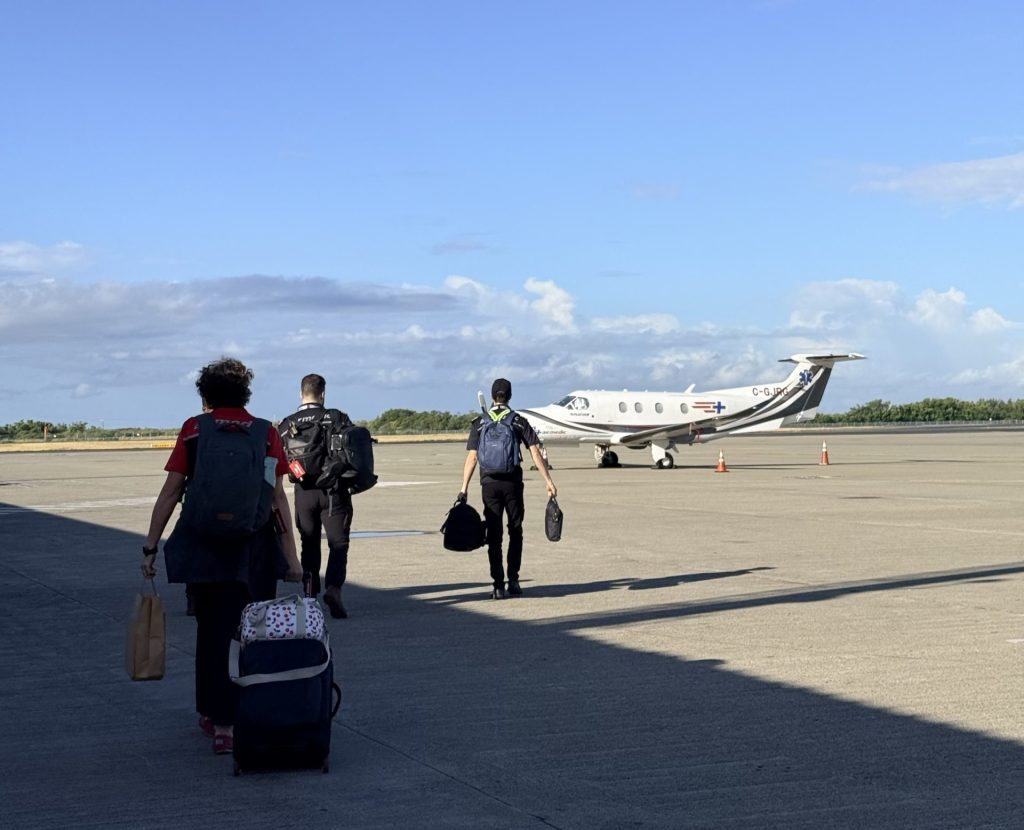
Colombia → Caribbean: A Bariatric Repatriation
Case study of an international mission operated on a Pilatus PC-12 NG

Mission Overview
| Route | Aircraft | Patient Profile | Context |
| Colombia → Caribbean via repositioning in Kingston (Jamaica) | Pilatus PC-12 NG Enlarged cargo door Bariatric stretcher | Bariatric profile Hospitalized > 3 months Condition requiring continuous monitoring | Mission assigned by an international assistance client |
Executive Summary
Airmedic recently completed a medical evacuation mission between Colombia and the Caribbean for a patient presenting a highly complex clinical and logistical profile: a bariatric case requiring continuous monitoring and prolonged hospitalization. As a result, the mission required a tailored solution, structured rigorously from planning through to the final transfer.
Airmedic organized an efficient operation combining strategic repositioning in Kingston (Jamaica), a direct flight between Colombia and the Caribbean, and rigorous interdisciplinary coordination. Through this integrated approach, Airmedic successfully completed the mission safely.
Mission Context
The mission was assigned by an international assistance client as part of a repatriation between Colombia and the Caribbean. It involved a long-distance transport of a complex bariatric case, with continuous care requirements throughout the entire journey.
The mission requirements were not limited to logistics alone, but rather to the compatibility between the patient’s clinical profile and the selected aircraft configuration.
Identified Constraints
The case combined three major constraints within a single mission.
1. Patient Profile
First, the case involved a complex bariatric profile, requiring a rigorous pre-transport feasibility assessment. This evaluation made it possible to determine the resources, equipment, and aircraft configuration appropriate for the patient’s clinical condition.
2. Limitations of Conventional Aircraft
Secondly, certain bariatric profiles create dimensional and logistical requirements that exceed the capabilities of standard aircraft configurations. In this context, aircraft selection becomes a clinical decision in itself.
Indeed, a large cargo door, a properly adapted bariatric stretcher, and unrestricted access points are all critical parameters for ensuring safe boarding without repeated handling. These were precisely the capabilities offered by the PC-12 NG for this mission.
3. An International Operational Environment
Finally, the mission required coordination across multiple aviation jurisdictions, Colombian hospital authorities, and receiving services in the Caribbean. Furthermore, the Colombian city, located at an altitude of 2,640 meters, introduced significant aircraft performance considerations for a medical-configured aircraft carrying a high patient load.
The Deployed Solution
Airmedic structured a solution built around three integrated components: aircraft selection, clinical coordination, and repositioning strategy.
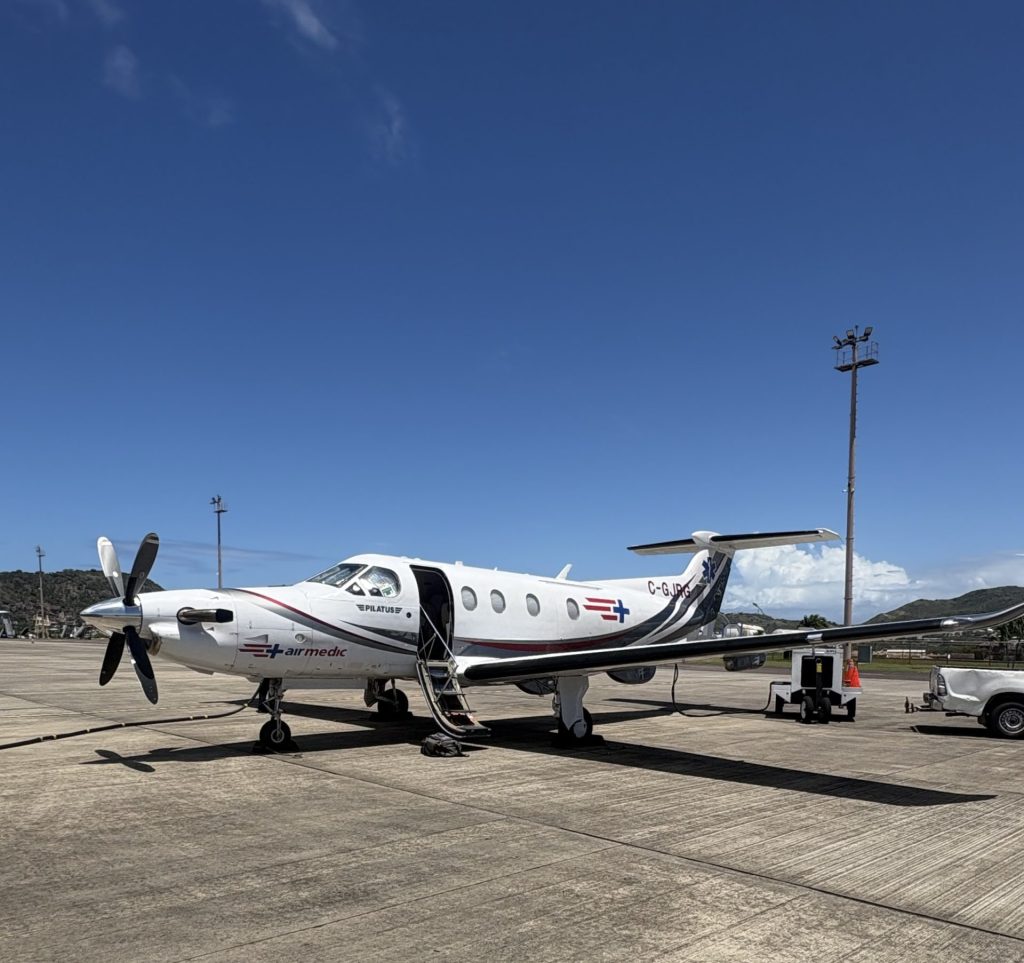
Component 1 — Aircraft Selection: Pilatus PC-12 NG
The Pilatus PC-12 provided the dimensional characteristics required for this case. Its main door measures 1.35 m × 0.61 m. More importantly, the aircraft features a cargo door measuring 1.37 m × 1.32 m, a significantly larger opening than standard configurations.
These features enabled the patient to be boarded using a bariatric stretcher (180 cm × 55.88 cm, expandable to 67.31 cm with arm extensions), equipped with a 64 cm adjustable seatbelt extension.
Beyond technical compliance, this aircraft choice also helped preserve the patient’s dignity throughout the transfer by avoiding the multiple handling procedures typically associated with this type of transport. Although often underestimated, this aspect remains central to the ethics of aeromedical transport.
Technical Comparison: PC-12 NG vs Learjet 45XR
| Parameter | Pilatus PC-12 NG | Learjet 45XR |
| Cargo door (W × H) | 1.37 × 1.32 m | Not applicable |
| Bariatric stretcher width | 55.88 cm (67.31 cm with extension) | 46 cm (standard only) |
| Patient width 60–70 cm | Compatible with extension | Equipment not adapted |
Component 2 — Clinical Coordination
From a clinical perspective, the team applied its internal bariatric transport procedure, structured in four sequential steps: receiving the complete medical file with updated measurements, feasibility screening by the on-duty clinical coordinator, direct validation with the Colombian hospital center, and anticipation of the additional resources required (third onboard crew member, adapted ground services, bariatric transfer team).
The team also prepared emergency evacuation equipment in advance, mobilized a bariatric ambulance service for ground transfers, and arranged the additional personnel required for heavy lifting in accordance with staff safety requirements. Finally, continuous monitoring was maintained throughout the entire transport, ensuring the patient’s clinical stability.
Component 3 — Strategic Repositioning via Kingston
Operationally, the aircraft was repositioned in advance to Kingston, Jamaica. Consequently, this strategic positioning made it possible to operate a direct flight between Colombia and the Caribbean while respecting regulatory crew duty-time limitations and preserving continuity of care.
Results and Impact
-
- Preserved dignity: direct loading through the cargo door eliminated the need for multiple handling procedures and intermediate transfers. As a result, the patient’s comfort and dignity were maintained throughout the transport.
-
- Crew safety: safe lifting techniques were applied with a minimum of three to four personnel involved in every patient movement, in accordance with internal injury-prevention requirements.
-
- Continuity of care: vital monitoring was maintained throughout the transport, with immediate reconnection of medical devices upon arrival and direct transfer to the local medical team.
-
- Regional operational validation: furthermore, the mission confirms Airmedic’s ability to operate its PC-12 fleet throughout Latin America and the Caribbean, thereby expanding the solutions available to assistance clients operating within the region.
Conclusion
This mission illustrates Airmedic’s operational reach. Originally established as a Canadian provider, the company now deploys its capabilities throughout Latin America and the Caribbean, where it can intervene in complex cases requiring equipment flexibility and international coordination. More specifically, the Colombia–Caribbean mission demonstrates four distinct Airmedic capabilities:
-
- Deploying solutions adapted to complex patient profiles, including bariatric cases exceeding standard thresholds.
-
- Leveraging a diversified fleet (PC-12 and Learjet 45XR) to maximize operational options according to mission requirements.
-
- Operating effectively in demanding international environments across both Latin America and the Caribbean.
-
- Delivering a reliable, flexible, and results-oriented solution for cases involving high clinical and logistical requirements.
This mission also reaffirmed three principles at the core of excellence in aeromedical transport: that aircraft selection is a clinical decision before it is a logistical one; that fleet diversity does not exist for its own sake, but rather to meet the uniqueness of each patient; and that the strength of a transport operation depends less on what is visible in flight than on the decisions made long before takeoff.
The question is generally not whether a mission can be completed, but whether it can be completed well.


