

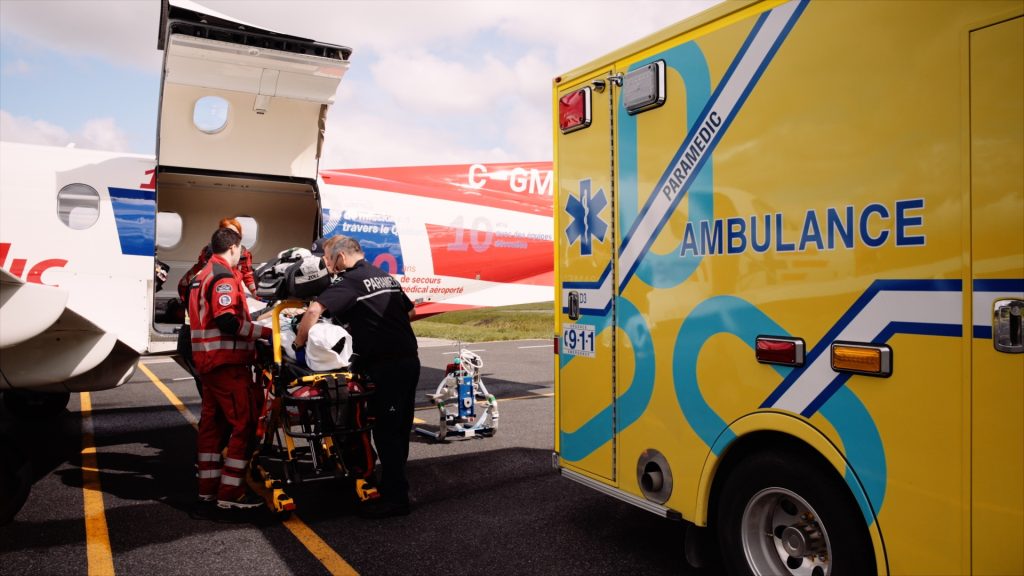
In the field of air medical transport, every complex intervention requires far more than simple patient transfer. It relies on the ability to respond rapidly, maintain continuous critical care, and adapt to environments that are often unstable and unpredictable. At Airmedic, this reality is an integral part of our expertise.
Through two recent interventions, one in Quebec and the other internationally, discover how our specialized teams adapt, coordinate, and ensure continuity of care in high-acuity clinical environments, from initial patient contact through to arrival at the receiving hospital.
In Quebec: a remote obstetric intervention driven by Airmedic’s expertise
In Quebec, particularly in remote regions, every minute counts and conditions can change rapidly.
While a team was already in flight for a planned mission, the aircraft was urgently redirected to an Indigenous community to respond to a critical obstetric situation. A patient, 28 weeks pregnant, was in active labor.
At the same time, a second Airmedic team took over the originally scheduled mission, ensuring continuity of operations.
On board, a specialized neonatal team, including a nurse trained in neonatal resuscitation and a respiratory therapist, enabled a rapid and appropriate response upon arrival at the local clinic, supporting the on-site teams and physician.
At birth, the newborn required immediate resuscitation. The team promptly initiated the necessary interventions, including continuous positive airway pressure ventilation, appropriate respiratory support, and the placement of an umbilical catheter for medication administration.
Coordinated resource mobilization to ensure continuity of care
In this context, the quality of the intervention depends equally on clinical expertise and the ability to coordinate resources in real time.
A third team was deployed from the Saint-Hubert base to deliver an incubator to the intervention site. This level of coordination ensured the safe transfer of both the newborn and mother to a receiving hospital with the specialized resources required for their care and ongoing follow-up.
Internationally: management of a severe traumatic brain injury (TBI)
Internationally, interventions present a different level of complexity, particularly when it comes to medical and logistical coordination.
During a stay in Central America, a traveler sustained a fall from several meters, resulting in a severe traumatic brain injury. Rapidly managed on site, he underwent multiple major interventions, including cranial reconstruction, spinal stabilization, and spinal canal decompression. Maintained intubated, mechanically ventilated, and under vasoactive medication and sedation, he required advanced medical support and a highly specialized care environment.
At the family’s request, Airmedic was mandated to coordinate and carry out a medical repatriation to the patient’s home country, ensuring seamless clinical continuity between healthcare facilities.
Complex air medical interventions: maintaining intensive care in flight
Physiological constraints related to altitude require heightened vigilance and precise control of clinical parameters. Every adjustment matters. Every decision has a direct impact on patient stability.
The deployed team, composed of a physician, a nurse, and a respiratory therapist, ensured continuous monitoring and immediate intervention capability throughout the flight. As such, air medical transport becomes a true extension of intensive care.
In parallel, close coordination with local medical teams, ground transport services, and receiving facilities ensured a seamless and safe transition at every stage of the care continuum.

Expertise in action
These interventions reflect a constant reality of air medical transport. Despite the diversity of contexts, certain elements remain essential, including adaptability, coordination, and the delivery of specialized care, regardless of the environment.
Beyond protocols and equipment, it is also a deeply human approach that guides every complex air medical intervention. For both patients and their loved ones, each mission represents a critical moment where safety, trust, and quality of care must be ensured.
At Airmedic, these principles are at the core of our mission and guide every intervention with rigor and excellence.


