

A patient on a ventilator, three professionals at their side, including a physician, and several hours of flight ahead. Inside an aircraft cabin, every centimetre counts. To design the new medical configuration of its Learjet 45XR, Airmedic drew on its experience in air medical transport, particularly aboard its Pilatus PC-12 fleet. An internal study conducted with the medical teams made it possible to put that expertise to work and to define the layout required for the Learjet’s missions.
The Learjet 45XR’s Medical Configuration in Four Decisions
Decision 1: Providing a Standardized Work Environment in the Medical Cabin
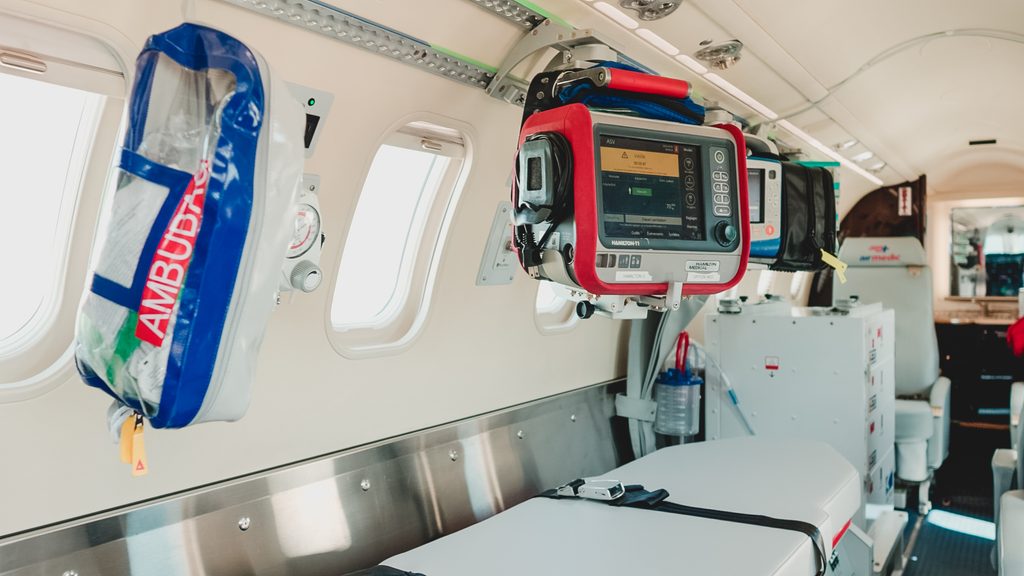
Airmedic first selected the same medical stretcher base already in use aboard the PC-12. The teams therefore work with familiar reference points for oxygen supply, electrical connections, equipment installation and stretcher handling.
This continuity simplifies training and mission preparation, while helping the team stay focused on patient care.
Airmedic then optimized the loading system. This makes the transfer from ambulance to aircraft easier and limits uncomfortable movement for the patient.
Field experience has confirmed the relevance of these choices. The second Learjet 45XR in Airmedic’s fleet is currently being reconfigured to the same standard.
“Our goal is not to make every aircraft identical, but to allow our teams to deliver the same level of care in a familiar, reliable clinical environment.” – Marie-Laure Denis
Decision 2: Enabling Professionals to Work on the Patient Simultaneously
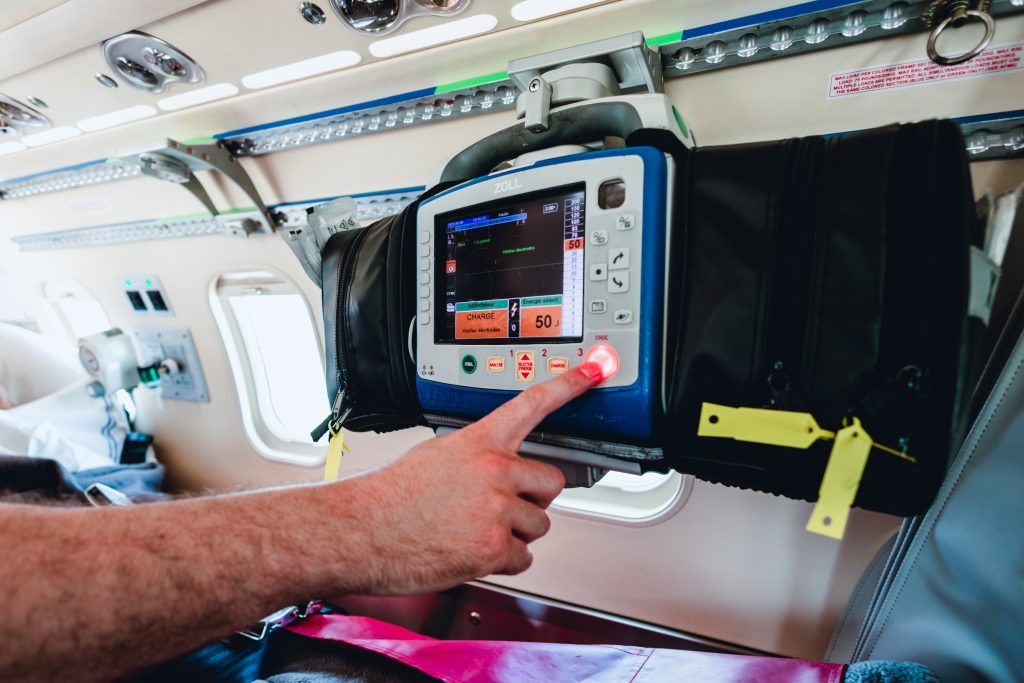
During a complex transport, several procedures may be required at the same time. The cabin must therefore allow the physician and the other team members to work together at the patient’s side. Equipment must also remain within reach and clinical data clearly visible.
Biomedical rails and custom mounts hold the equipment in place and organize the work area. The layout keeps the area around the patient’s head clear, which makes rapid airway management easier when required.
This arrangement makes it possible to adapt the cabin to the patient’s needs, to the equipment required and to the composition of the accompanying team.
Decision 3: Supporting Clinical Autonomy in Flight
Preparing a transport does not rest on the patient’s diagnosis alone. Flight duration, destination, the equipment required and the resources available on arrival are also part of the assessment.
Once in flight, the team must have the supplies and reserves needed to continue care and respond to the unexpected.
The medical cabin was therefore configured to accommodate a range of patient profiles, from neonatal to bariatric patients, as well as patients requiring psychiatric care. The stretcher platform’s compatibility with specialized equipment makes it easier, among other things, to install an incubator for a neonatal transport.
Several tools make it possible to assess the patient and adjust care during the flight. The i-STAT analyzer provides blood test results on board. Ultrasound complements bedside assessment, while suction regulators maintain the suction required for certain chest tubes.
Oxygen requirements are also carefully planned. Reserves are added to the expected consumption to cover a delay, a diversion or a deterioration in the patient’s condition. Skytrac satellite communication provides an additional means of consulting medical resources on the ground.
Spending several hours lying down in a medically equipped aircraft can be demanding. The environment is unfamiliar, the equipment is extensive and loved ones are often far away. Patient comfort and dignity must therefore be part of the layout decisions.
A privacy curtain helps preserve the patient’s modesty during care. The cabin layout makes it easier to work around the patient, while dedicated storage keeps supplies organized and within reach.
The stainless steel medical panels and the purpose-selected flooring make cleaning and decontamination between missions easier, both essential to infection prevention.
A Continuous Improvement Approach
This medical configuration builds on the expertise developed at Airmedic over the years. It brings together what the teams have learned, the experience gained across different aircraft and the specific requirements of the Learjet’s missions.
Every design choice answers a concrete need: reaching equipment quickly, working at the patient’s side, carrying sufficient reserves or protecting the patient’s privacy. The work was also carried out in line with the standards and requirements of the EURAMI accreditation held by Airmedic.
See the full features of the Learjet 45XR medical cabin on video
About the Author
Marie-Laure Denis, inf. Director, Growth and Operational Performance, Airmedic. A critical care nurse by training and former Director of Medical Operations at Airmedic.
Also read: Galápagos → United Kingdom: an intercontinental medical repatriation with two patients
Need a medical repatriation?
Airmedic’s coordination centre is available 24 hours a day, 7 days a week, to assess your request and arrange a medical transport suited to your needs.


